
Precision Strikes in the Digital Age: Reimagining Offensive and Defensive Capabilities
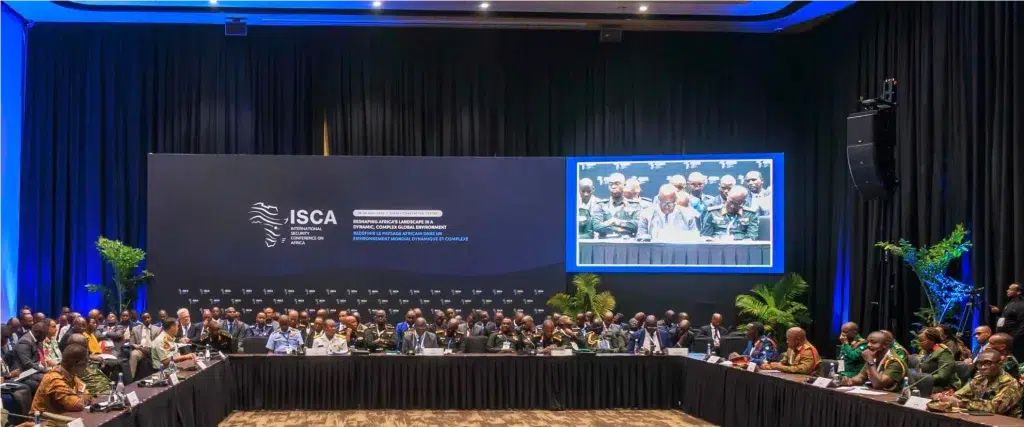
The roundtable, “Precision Strikes in The Digital Age: Reimagining Offensive and Defensive Capabilities,” provided a critical and timely assessment of Africa’s strategic encounter with contemporary military technology. Participants from the defense, academic, and policy communities agreed that Africa’s operational security landscape has become markedly more complex. The blurring lines between conventional and asymmetrical threats—including terrorism, cyberattacks, and transnational crime—demand not only technological adaptation but, crucially, a transformation in institutional frameworks, human capital, and strategic cultures.
One of the central themes was that no technology, regardless of its sophistication, can by itself ensure deterrence or operational success. Rather, security depends on how technology is integrated into strategy, doctrine, and force structure, as well as on the quality of local expertise and the flexibility of military organizations. The panel noted the rise and utility of precision weapons, drones, and network-centric systems that theoretically enable pinpoint strikes and the neutralization of adversaries with minimal collateral damage. Such innovations, however, achieve their promise only when matched by rigorous training, robust modeling and simulation, and institutional learning. Without investment in human capital—the engineers, operators, tacticians, and analysts who convert platforms into effective military power—African militaries risk becoming mere consumers of imported gadgetry, with little capacity to shape outcomes or to adapt as technologies and threats evolve.
A recurring point in the discussion was the continent’s pervasive “asymmetrical exposure.” Most African nations remain dependent on foreign suppliers for strategic technology, making them vulnerable to the shifting priorities and interests of external powers. This dependency is compounded by weak local Research and Development ecosystems and an underdeveloped capacity to innovate, adapt, and maintain high-tech military systems. The roundtable warned that sovereignty in the digital age is undermined when control over critical systems, software, and supply chains is ceded to external actors. In this setting, even the acquisition of advanced weaponry may serve more to reinforce the strategic objectives of foreign states than African security itself. Achieving a measure of autonomy requires African nations to establish indigenous research and development departments, form partnerships between military, academia, and industry, and set policy frameworks that prioritize long-term technological self reliance over short-term procurement wins.
The operational value of digital-age weapons is fundamentally linked to the ability of states to institutionalize specialized training. The roundtable emphasized the necessity for ongoing education in targeting, weapons systems operation, cyber defense, and the coordination of joint and multi-domain operations. Simulation and modeling were highlighted as critical enablers for translating theory into practice—allowing forces to test scenarios, adapt tactics, and rehearse operations prior to actual engagement. Such tools are not only financially prudent, but also essential for fostering a culture of lessons-learned and evidence-based doctrine. Yet, panelists cautioned that technology must be democratized beyond elite special units; for precision to be effective, tactical and strategic competence must be distributed throughout all levels of command.
Interdependence and collective action were identified as both challenges and imperatives for Africa’s security future. Transboundary challenges—from cyber incursions to illicit arms flows and regional terrorist networks—cannot be adequately addressed by fragmented national approaches. The roundtable noted, Africa’s security sector has persistently failed to establish robust regional coalitions founded on solidarity, mutual interest, and trust. Divisions among states, sometimes exacerbated by cooperation with external actors at the expense of neighbors, hinder information sharing and the pooling of resources necessary to achieve scale in technology acquisition, training, and doctrine development. To counter this, participants advocated for continent-wide or at least supranational legal and institutional standards for intelligence, procurement, training, and the management of emerging technologies. Regional centers of excellence, joint research initiatives, and harmonized legal frameworks were recommended to promote efficiency, confidence, and collective deterrence.
A related issue is the fractured nature of Africa’s defense industrial and knowledge base. The roundtable lamented the rare presence—and even rarer coordination—of institutions tasked with bridging technological gaps. Often, local production and innovation are stifled by regulatory hurdles, insufficient funding, or a lack of vision, relegating Africa to the position of a market for, rather than a source of, new military technology. The absence of indigenous nuclear deterrence capabilities was cited as a strategic vulnerability, though panelists stopped short of advocating nuclear proliferation. They instead stressed the need for broader deterrence postures, emphasizing cyber capabilities, robust intelligence, and regionally integrated command and control structures as fitting and more immediately achievable objectives.
The cost of digital security infrastructure was acknowledged as prohibitive, but roundtable members insisted that investment costs must be weighed against the value for money gained from efficient, precision-capable forces. Strategic acquisitions should be guided by careful assessment of operational needs, environmental constraints, and the potential for local adaptation and cost recovery. To ensure the greatest return on investment, intellectual collaboration among African military planners, academic researchers, and private industry was encouraged to foster the indigenous development of scalable, context-appropriate solutions.
The roundtable also recognized the importance of robust situational awareness—enabled by networked sensors, persistent surveillance, and real-time data analysis—as a core pillar of modern deterrence. Advances in digital technology permit a higher tempo of decision-making and the rapid application of force, but only when matched by well-trained personnel and resilient information systems. Because today’s threats are fluid, Africa’s security sector must remain adaptive, continuously assessing and updating both technologies and tactics through institutionalized feedback loops.
In summary, the session made clear that Africa must reimagine its approach to deterrence, offense, and defense in the digital age. This entails not only acquiring new hardware but, critically, developing the human capital, institutional innovation, and regional partnerships necessary to own, operate, and continuously adapt cutting-edge capabilities. Strategic autonomy will be realized not through the passive adoption of foreign solutions, but through active collaboration, endogenous Research and Development, and a shared commitment to solidarity and knowledge exchange across the continent. Only then can Africa move from the margins to the center of military and security innovation, ensuring that its resources, talent, and strategic choices serve the interests and aspirations of its own peoples rather than those of external actors.
©2026 - International Security Conference on Africa (ISCA). All rights reserved.